In Defense of Populism by Donald T. Critchlow
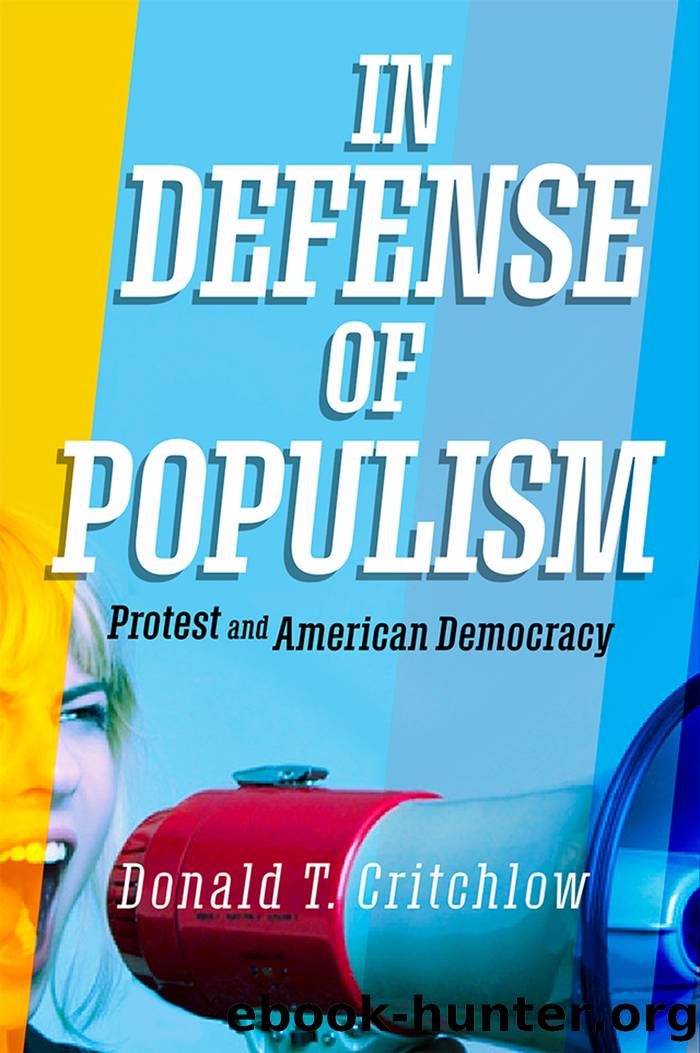
Author:Donald T. Critchlow
Language: eng
Format: epub
Publisher: University of Pennsylvania Press, Inc.
Published: 2020-11-14T16:00:00+00:00
Second-Wave Feminism Launched
The struggle for womenâs rights had a long history before Friedan wrote The Feminine Mystique. Female struggle for equality was not new to the country and had deep roots in the nationâs history dating back to preâCivil War reform movements. Feminist activism expressed itself in the suffrage movement at the turn of the twentieth century, the formation of the National Womenâs Party in 1920, welfare reform labor activism, support for an Equal Rights Amendment, and debates about gender equality among the preâWorld War II left.5 Feminism found new energy in the early 1960s in the fight for civil and employment rights for women; by the late 1960s the movement accelerated into direct, vocal, and angry challenges to patriarchal domination in politics, culture, and sexual relations. Second-wave feminism proved more transformative, however, politically, culturally, and socially. It arguably was the most successful social movement in modern American history in its effects on government policy, the workplace, and sexual and marital relations. The movementâor perhaps more accurately described as movements because of the multiplicity of female voices involvedâbecame increasingly radicalized. This radicalization, however, coincided with more tempered, although no less significant, changes in popular culture, experienced by women and men mostly in the middle class, in social consciousness about the roles and place of women in society.
Women had found new opportunities in modern, industrial, and urban America at the turn of the twentieth century. Although employment opportunities remained limited, women gained political agency when they won the right to vote with the enactment of the Nineteenth Amendment in the 1920s. In the Roaring Twenties, young urban women smoked, wore short skirts, drank, and flaunted their disregard for Victorian sexual conventions. Many more women entered college and the workforce. These trends continued into the 1930s and further accelerated during World War II when the shortage of male workers required a greater reliance on female workers in war production.6 The war, however, disrupted traditional patterns of behavior.7 After World War II, many women left the workplace to return home, but large numbers continued to work. Support for work by married women was widely accepted by the public. By 1954, in families earning middle-class incomes of $6,000 to $10,000, both husband and wife worked. Increasingly women entered college; so by 1968, more than 43 percent of all bachelorâs and professional degrees went to women. In this environment, times were ripe for the emergence of a revived and new feminist movement.
Equal rights for women took a major step forward in 1961 when Esther Peterson, head of the Womenâs Bureau in the Department of Labor, pressured President John F. Kennedy to create a special commission on the status of women in the United States. Many women, including former first lady Eleanor Roosevelt, were sorely disappointed in the failure of the administration to appoint more women to government.8 Peterson was the highest-ranking woman in the Kennedy administration. Kennedyâs reluctance to appoint women to higher positions in his administration drew inevitable criticism from women. Furthermore, Kennedy refused
Download
This site does not store any files on its server. We only index and link to content provided by other sites. Please contact the content providers to delete copyright contents if any and email us, we'll remove relevant links or contents immediately.
| Anthropology | Archaeology |
| Philosophy | Politics & Government |
| Social Sciences | Sociology |
| Women's Studies |
Cecilia; Or, Memoirs of an Heiress — Volume 1 by Fanny Burney(32558)
The Great Music City by Andrea Baker(32019)
Cecilia; Or, Memoirs of an Heiress — Volume 2 by Fanny Burney(31956)
Cecilia; Or, Memoirs of an Heiress — Volume 3 by Fanny Burney(31942)
We're Going to Need More Wine by Gabrielle Union(19046)
All the Missing Girls by Megan Miranda(16027)
Pimp by Iceberg Slim(14507)
For the Love of Europe by Rick Steves(14121)
Bombshells: Glamour Girls of a Lifetime by Sullivan Steve(14075)
Talking to Strangers by Malcolm Gladwell(13370)
Norse Mythology by Gaiman Neil(13365)
Fifty Shades Freed by E L James(13240)
Mindhunter: Inside the FBI's Elite Serial Crime Unit by John E. Douglas & Mark Olshaker(9343)
Crazy Rich Asians by Kevin Kwan(9292)
The Lost Art of Listening by Michael P. Nichols(7506)
Enlightenment Now: The Case for Reason, Science, Humanism, and Progress by Steven Pinker(7313)
The Four Agreements by Don Miguel Ruiz(6765)
Bad Blood by John Carreyrou(6621)
Weapons of Math Destruction by Cathy O'Neil(6280)
